Tag Archives: Tow Truck Chicago

Common Towing Mistakes

Common Towing Mistakes

Hitching a trailer to your truck and hauling out all your belongings on the open road sounds exhilarating for many people – but if you’re not skilled with long heavy tows it can be an incredibly complex process. There’s 8 major mistakes that people usually make when they’re towing. If you want to avoid paying extreme fees for mistakes, educate yourself on this list of potential mishaps before you embark.


Having the Wrong Weight Distribution Bars

The weight distribution bars between your vehicle and trailer have to be set up correctly; otherwise, the vehicle and the trailer will be bouncing away from each other – causing a bumpy ride, and potential damage to the trailer’s frame and hitch. The size of the weight distribution bar shouldn’t matter – many tunable chained bars come in many different levels of strength or weight – if you use the right bar size, it will be completely parallel to the frame of the trailer.

Read More →

Five Most Common Tow Truck Types

common tow trucks types

There’s five kinds of tow trucks in general usage. In this short blog post, I’ll detail the different ones, and how they operate. At Chicago Towing we focus on the 2 main types  wheel-lift and flat bed towing

Flatbed Tow Trucks

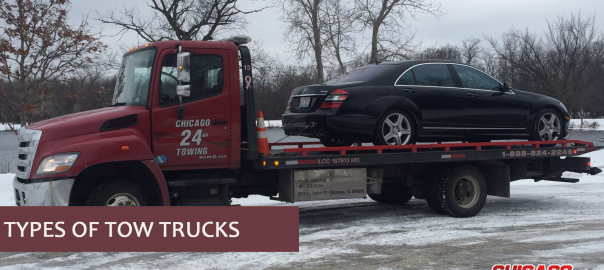
Flatbed tow trucks are also known as “slides” or “rollbacks.” The entire rear area of the truck is attached with a bed that can be hydraulically inclined and shifted to a ground level, allowing the vehicle that’s getting towed to be pulled onto it easily.

Booms Tow Trucks

These tow trucks use adjustable boom winches to rescue vehicles from any area that’s hard to reach for a vehicle. Booms are used to recover vehicles from ditches, craters, or natural embankments. Some booms are fixed to the truck, while others have pivoting A-frames, or pneumatically fueled telescopic tubes.

Wheel-Lifts Tow Trucks

Otherwise known as “spectacle” lifts due to their resemblance to square eyeglasses, this method of towing involves a metal yoke that’s placed under the front or back wheels of a car to hold them, dragging an end of the car up off the ground with a pneumatic or hydraulic hoist so that it can be towed. Usually, these devices lift the drive wheels of the vehicle, only touching the tires.

Integrated / Repo Trucks

This method of towing involves a wheel-lift and a boom synthesized into a single unit. Commonly used in light duty towing in order to quickly move illegally parked, or repossessed vehicles, many of these trucks have the towing controls inside the truck’s cab, to make the pickup as easy as possible – there’s no need to even exist the vehicle. Industrial grade heavy duty trucks are made with integrated lift options. Similar to integrated trucks, some specialty flatbed units carry wheel-lifts, and some wheel-lifts offer combined booms and slings.

Identify a Professional Towing Company Chicago

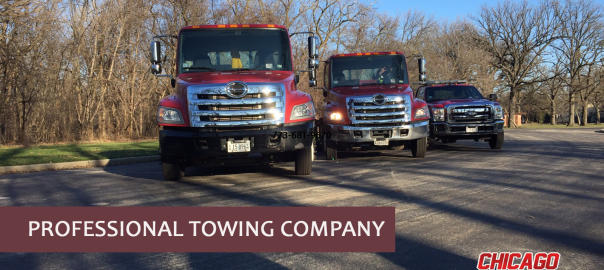
Chicago Towing Company

All professional towing companies in Chicago, IL:

  • Have tow trucks with a bed that tilts down to help loading and unloading (a rollback truck) or a wheel-lift truck – as well as knowing all the potential limitations, and all the advantages of their trucks.
  • Has equipment for loading your vehicle that’s proper. For a rollback truck, this would include a bridle with hook to hook slots in the frame, not simply a large “J” hook. Some vehicles, if they can’t be put into neutral, might need specialized equipment known as “skates” that can help load and unload the car.
  • Has the equipment for safely securing videos including ratchet straps, chains, and the proper type of hooks. All vehicles should be secured with at least four points. Sometimes wheel straps are needed, usually with high end cars. All professional towers have training with – and access to information detailing the proper methods of securing various makes of cars.
  • Has their trucks inspected annually, with a publically displayed, dated and signed sticker showing that the inspection occurred.
  • Meets all federal and state regulations including the public display of DOT number, company name, and place of origin – as well as all triangles, flares, cones, amber beacons, light  bars, or fire extinguishers that may need to be used during transport.
  • Professional Towing Company drivers who have completed medical exams, carry “med cars” and if needed, have Commercial Driver’s Licenses which point towards a high level of training.
  • Stop at scales, as required when carrying loads greater than 10,000 pounds.
  • Carries insurance that covers their own vehicle, as well as “on-hook” and “garage-keeper’s” insurance that covers your vehicle while it’s in their care.
  • Has contracts or agreements with motor clubs and insurance agencies for direct payment, or no questions on reimbursement.
  • Has all safety vests and equipment to make themselves vehicle at any scenes of disability.
  • Have skills, training, certification, and experience about towing, recoveries, lock-outs, jump-starts, tire changes, and winching. The certification that can be obtained from organizations like the International Institute of Towing and Recovery, the Towing & Recovery Association of America, or Wreckmaster are all great ways of insuring a towing company’s professionalism.

Why use a professional towing company in Chicago?

A truly professional tower:

  • Can safely secure your vehicle to prevent any damage in the event of a sudden stop or accident.
  • Is unlikely to damage your vehicle during loading and unloading by improperly pulling on something, or by allowing a vehicle to row away.
  • Can tow vehicles with collision insurance to a body shop, and get paid by the body shop, so that the collision insurance pays for the tow and repairs as a single charge. If you’re getting emergency roadside assistance, the tower should be able to directly bill AAA or insurance agencies, or if you have the proper insurance coverage, provide you with an itemized invoice that you can submit for reimbursement.
  • Can accept checks or credit cards.
  • Can provide emergency roadside assistance: including tire changes, lock-outs, jump-starts, and recoveries. The company should additionally be skilled, and experienced in providing these services, as they require an element of talent, finesse, and understanding to undertake safely.
  • Maintains trucks to a high standard -(you don’t want to be left stranded because of a broken tow truck.)


The question that you should ask yourself is: would you rather entrust your vehicle to a skilled professional, or someone without the training and experience to safely service your vehicle without causing damage. The answer should be obvious. Always:

  • Verify the Chicago Towing company’s name, place of origin, and DOT number on the side of the truck.
  • Verify the commercial inspection sticker near the above information.
  • Inquire about all certification, experience, and training.
  • Look for required safety light bars, reflective clothes, or any other safety gear.
  • Look for equipment appropriate for winching, loading, unloading, and securing your vehicle.
  • Expect professional, courteous, timely service over the phone and in person.
  • Look for a professional looking business area.
  • Ask about “on-hook” and “garage-keeper’s” insurance.


Look out for Unprofessional towers who:

  • Put more emphasis on price over service and quality.
  • Don’t have insurance.
  • Don’t follow laws requiring signage, official publically displayed certification, safety equipment, lights, gear, truck inspections, etc…
  • Will claim that they don’t have to check at scales.
  • Don’t have special equipment to safely load, unload, and secure your vehicle.
  • Isn’t able to provide other services associated with towing, like lock-outs or recoveries.
  • Don’t have contracts or agreements with insurance companies, motor clubs, or body shops to provide direct billing or easy insurance reimbursement through a professional invoice.
  • Isn’t on the Trooper’s list with a file with rates and insurance.
  • Don’t leave beacons and lights on the scene of a disabled vehicle for safety.
  • Can’t always answer your call or provide you service at any time.
  • Can’t handle credit card or check payment.

8 Great ways to avoid being towed in Chicago

8 Great ways to avoid being towed in Chicago

Even if it seems like a rare occurrence, it’s actually not that rare that cars find themselves getting towed. Here’s eight great tips for avoiding ever having to deal with getting your car towed in Chicago.

  1. Try not to park in common towing spots

These spots vary from place to place – but in most areas, blocking active driveways, intersections, and curb ramps is a sure way to get towed. Many areas also have laws determining how long you can keep your vehicle street parked. It’s worth it to become familiar with the laws regarding parking, driving, standing, and stalling in your area. As a ground rule though, never park by

  • Bus Stops
  • Loading Zones (usually marked with yellow)
  • Blue Zones (if there’s not a disabled person marker on your vehicle)
  • Red zones (curbed painted Red)
  • Tow Away zones during normal commuting hours.


2. Always Read Street Signs

It’s important to read these carefully, especially when you’re in commercial areas with high traffic. Police and traffic officers tow illegally parked cars much more often, and with a much greater number in high traffic areas – which also often carry much more parking restrictions.


3. Be aware during commute hours.

During crowded evening and morning commutes, many cities bar parking on many streets. A certain parking space could be completely legal at 2pm, but would get your car towed at 3pm. You have to be aware of what the parking ordinance for that space is – even when you’re at a meter. The usual peak commute hours are from 7am to 9am and from 3pm to 7pm.


4. Call a tow company yourself.

Don’t rely on city services to tow your car if it breaks down. Call a private towing company in Chicago or roadside assistance agency yourself.


5. Pay all outstanding traffic tickets.

In some areas, cars with delinquent parking tickets can be booted or even towed – this can happen even if your car is in a perfectly legal parking space. If your car gets booted, you’ll have to pay an extra cost to remove the boot. Booting and towing, added with tickets and time penalties add up to a lot of money. You can avoid this if you pay your parking tickets.


6. Avoid getting parking tickets in the first place.

  • Set an alarm on your phone to remind you that the meter is about to expire.
  • Keep a bunch of quarters for meters in your car.
  • If it’s offered in your area, buy a prepaid parking card.
  • Mark your calendar with the street cleaning schedule and no-parking times for the areas that you frequent.


7. Keep current vehicle registration.

All police have the right to tow and potentially impound your car if your registration isn’t current when you’re stopped by a police officer.


8. Always keep your driver’s license current.

If you’re ever stopped by police while you’re driving, and your license has expired or is otherwise illegible or not current, the police have the right to tow and impound your vehicle if nobody else is available inside the car to take over the wheel.