Category Archives: Chicago Towing

Chicago Towing Company: Provides tow trucks in every part of Chicago ready to serve you should you need it. Today we perform light duty towing, medium duty towing, commercial towing, emergency roadside assistance, lockouts, auto, 24 Hour Emergency, Towing jumpstarts, Roadside Assistance Chicago, Flatbed Towing, Motorcycle Towing, Commercial Towing Services, Accident Recovery Towing, Car Refueling Service Chicago, Car Locksmith, Junk Cars For Cash
Ignition Key Replacement, Off Road Vehicle Recovery, Vehicle Jump-Start, Chicago, Tire Change or Replacement, Local Towing Service, Long Distance Tow

Common Towing Mistakes

Common Towing Mistakes

Hitching a trailer to your truck and hauling out all your belongings on the open road sounds exhilarating for many people – but if you’re not skilled with long heavy tows it can be an incredibly complex process. There’s 8 major mistakes that people usually make when they’re towing. If you want to avoid paying extreme fees for mistakes, educate yourself on this list of potential mishaps before you embark.


Having the Wrong Weight Distribution Bars

The weight distribution bars between your vehicle and trailer have to be set up correctly; otherwise, the vehicle and the trailer will be bouncing away from each other – causing a bumpy ride, and potential damage to the trailer’s frame and hitch. The size of the weight distribution bar shouldn’t matter – many tunable chained bars come in many different levels of strength or weight – if you use the right bar size, it will be completely parallel to the frame of the trailer.

Read More →

Heavy Duty Towing Safety Tips

Heavy Duty Towing Safety Tips

There’s variable reasons that cause a car to need to get towed. Whether you suffer an unfortunate accident in your vehicle, or if it breaks down on the highway, you should know the proper safety measures that both you and any towing specialist you may contact should take on the road, to protect your safety.

Driver Safety Tips

If you’re in the middle of driving and need to pull over to get towed, it’s absolutely necessary to follow these safety tips. First of all, move your car as far away from other cars as possible. If there’s a shoulder to the road, move onto it as soon as possible, as close to the edge as you can. Additionally, leave your hazard lights on – this is particularly important at night – so other drivers driving can see you, and also so the towing company can have an easier time recognizing you. If you have an emergency roadside kit in your car, place reflectors around the perimeter of your vehicle.

As you’re waiting for the tow company to get there, take anything that you might need (like license information, insurance records, registration, etc…) out of the car before it’s towed. It might be a few days before you see your car and you’re going to need to provide this information to the towing service during the process. While you’re waiting for the towing company to get there, make sure to wait inside the car, so you don’t put yourself at risk for the passing cars or any weather that might be occurring.

The Heavy Duty Towing Truck Safety Tips

Not only does the initial driver of the vehicle need to take safety measures to ensure the protection of their being and their vehicle’s being in the event where a towing is necessitated, but the driver of the tow truck that will transport your vehicle absolutely needs to follow safety measures.  One of their initial steps is to increase the visibility of your stranded vehicle, by placing cones and flags around the area. This is to protect both you and them from oncoming traffic.

Tow truck drivers are also required to check whether their cable lines are intact, and not damaged. They need to make certain that their truck is capable of hauling your stranded vehicle safely. This information will be verified over the phone upon your first contact. Drivers additionally have training to never unwind the towing cables all the way when they’re loading a vehicle, and to make sure that the wheel-lift is extended far enough after the loading that they can safely and easily make turns. Drivers are also trained to avoid any electrical lines, and ensure that bystanders stand a safe distance during the entire towing process. All these safety measures are completely necessary – the operation of towing requires a great deal of safety attention, and drivers for the right company are thoroughly trained in all these measures to protect both their own neck, but yours, and that of your vehicle.

21 Essential Road Trip Tips

road trip tip Chicago towing

If you’re planning on traveling through the United States on a road trip, driving without stopping has advantages – you’ll save money on hotels, have more time once you get to your destination – not to mention the sense of exhilaration you get on a nonstop drive. However, in order to stay safe and energetic, it’s integral to follow these tips to make sure your ride goes smooth.

Get a good night’s sleep before the journey

Scientific studies have shown that missing a few hours of sleep can impair your driving to a comparable level to being intoxicated with alcohol. Don’t let this happen by making sure that you get a lot of sleep the night before you leave.

Wear Sunscreen

This is a very underrated tip. If your skin is in direct sunlight for hours at a time, your skin is going to be exposed to harmful UVA rays. You’re going to need sunscreen to protect your exposed skins from getting burns. Apply liberally, and repeat when necessary.

Eat Nutritiously

Don’t just eat roadside fastfood. Instead of stopping at a drive through, stop at a supermarket, and get salad, fruit, or a hearty sandwich – rather than fried food that won’t give you the nutrition you need through your journey.

Avoid Staying at Rest Stops

Pulling over and sleeping in your car can be dangerous – and it’s illegal in some states. We don’t recommend it. Use rest stops to stretch your legs, get a snack, or go to the bathroom. Then get back on the road.

Read More →

Common Car Towing Questions

car towing company chicago

Can tow trucks tow the car backwards?

Most tow trucks can hook themselves up to the front or the back of the vehicle that’s being towed. This is actually the ideal (and most widely used) method for vehicles with rear wheel drive, although front or all-wheel drive vehicles can also be towed from the back if the car’s front can be lifted with a pulley or dolly.

Can your car get towed if you’re touching it?

Absolutely not. In order to complete the towing job safely, the tow truck driver will need you to stand away from your vehicle. If you’re physically blocking the car from getting towed, If your car is being towed due to legal injunction, and you’re physically blocking it from getting towed, the driver might contact the police to escort you away – which may result in a fine or civil charges of obstruction.

How can I prevent my car from being able to get towed by a roll-back or flatbed tow truck?

These trucks get their name from their flatbed that tilts backwards so that vehicles can get rolled on to it for transporting. These trucks usually transport strangely shaped, damaged, or large vehicles – but also commonly tow regular cars. Since the flatbed’s driver needs to position the truck directly in line with the car so that it can be winched up, you can prevent one of these trucks from being able to  tow you by parking somewhere there the flatbed truck can’t reach the front or back of the car.

Read More →

Five Most Common Tow Truck Types

common tow trucks types

There’s five kinds of tow trucks in general usage. In this short blog post, I’ll detail the different ones, and how they operate. At Chicago Towing we focus on the 2 main types  wheel-lift and flat bed towing

Flatbed Tow Trucks

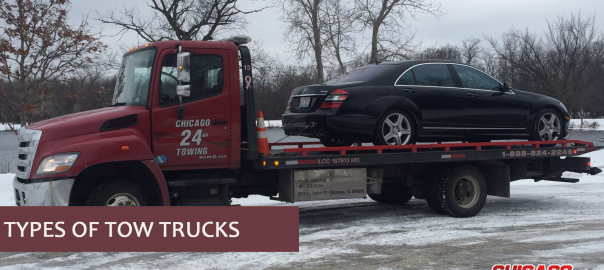
Flatbed tow trucks are also known as “slides” or “rollbacks.” The entire rear area of the truck is attached with a bed that can be hydraulically inclined and shifted to a ground level, allowing the vehicle that’s getting towed to be pulled onto it easily.

Booms Tow Trucks

These tow trucks use adjustable boom winches to rescue vehicles from any area that’s hard to reach for a vehicle. Booms are used to recover vehicles from ditches, craters, or natural embankments. Some booms are fixed to the truck, while others have pivoting A-frames, or pneumatically fueled telescopic tubes.

Wheel-Lifts Tow Trucks

Otherwise known as “spectacle” lifts due to their resemblance to square eyeglasses, this method of towing involves a metal yoke that’s placed under the front or back wheels of a car to hold them, dragging an end of the car up off the ground with a pneumatic or hydraulic hoist so that it can be towed. Usually, these devices lift the drive wheels of the vehicle, only touching the tires.

Integrated / Repo Trucks

This method of towing involves a wheel-lift and a boom synthesized into a single unit. Commonly used in light duty towing in order to quickly move illegally parked, or repossessed vehicles, many of these trucks have the towing controls inside the truck’s cab, to make the pickup as easy as possible – there’s no need to even exist the vehicle. Industrial grade heavy duty trucks are made with integrated lift options. Similar to integrated trucks, some specialty flatbed units carry wheel-lifts, and some wheel-lifts offer combined booms and slings.

Rural, Suburban, and Urban Towing Chicago

Rural, Suburban, and Urban Towing Chicago

Towing is affected by Terrain

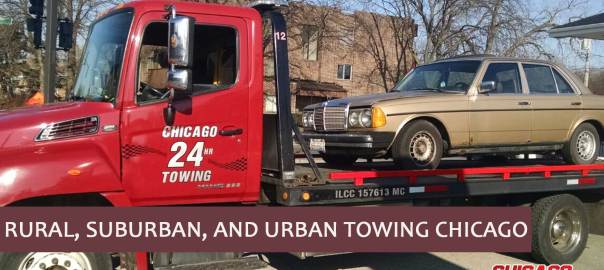
Towing is a technically complicated process. Tons of variables exist which can affect the speed and quality of any trip. Rural Towing involves traveling greater distances, and may involve travel over rocky or unpaved terrain. Sometimes special equipment is needed to travel throughout rural environments. Cell phone reception may be limited when traveling through particular terrains and climates, specifically mountains and deserts. Sometimes, for 4×4 off-road vehicles that need to be towed in rough environments full of mud or rocks, special vehicles or gear is required. Extra gear is never thought of as an optional excess – rather it’s a necessary tool to protect your vehicle, so it doesn’t incur any extra damage.

Smooth Sailing in Urban Chicago

Urban towing is, by its very nature, more common than rural towing. Due to transportation infrastructure, the trips are often much faster. However, due to urban population saturation, there’s much more traffic in cities than in suburban areas. This is why our customers benefit from our servicemen’s experience with navigating the busy Chicago streets. They’re aware of all the traffic flows, patterns of commuting, and the spots that tend to get congested. Essentially, the city is their turf, and they know exactly how to get through it, as quickly as possible.

Experienced Navigators

Chicago Towing is an automotive towing company (servicing cars, vans, motorcycles, trucks, RVs, and pick-up-trucks) in the bustling city of Chicago. We serve the entire metropolitan area, from the I-90 – the Chicago Skyway, Dan Ryan Expressway that runs throughout the city of Chicago, connecting Downtown with the South Side. In this entire area, we are the premiere towing service; our experience allows us to set ourselves apart by offering the smoothest, most efficient service, regardless of if you’re in Downtown Chicago, the suburbs, the freeway, or the countryside. There’s simply nobody better equipped to handle your vehicle


8 Essential Safety Tips for Family Road Trips

8 Essential Safety Tips for Family Road Trips

If you’re getting ready to embark on a long, family road trip, it’s best to ensure safety – and pleasure – if you develop and act on a checklist that you follow prior to leaving. In this blog post, I’ll list a number of the criteria that I’ve developed on my own checklist before a family vacation last summer. Feel free to add as you go – this list simply acts as a great initial structure to follow which will take care of all the safety essentials. Here we go.


Tip One – Keep your Phone Book Full

Make sure to program a bunch of contacts into your phone before leaving on your trip. You want to be able to have all the phone numbers of your family, doctors, neighbors, and even tow truck companies that you might need to reach in the event of an emergency.

Tip Two – Keep your Cell Phone on Hand

Make sure to always carry your cell phone, maps, and GPS navigation system with you during the entire course of your trip. Additionally, research the route you’re taking before you leave, so that you know you have the proper directions. It will save you alot of last minute ground work.

Tip Three – Make sure your vehicle is Happy

Before leaving, check the fluid levels of your vehicle, and inspect its tires, hoses, and belts. You want to be certain that all aspects of your car are working correctly before you leave, so there’s no nasty surprises. If you get stuck on the road always have an emergency number for an expert roadside assistance company.

Tip Four – Back up Car Gear

In the event of an automobile malfunction, you want to be prepared. Make sure to bring an inflated spare tire with you, as well as a jack and a lug wrench – you would need both these tools in the event of a tire blowout, or a damaged tire.

Tip Five – Make sure your tires are full.

You’re going to want to check the air pressure of all 4 of your tires, according to the specifications in your vehicle’s owner’s manual. Driving with under-pressured tires can result in dangerous sidewall blowouts, and a level of poor traction that can make drivers totally lose control of their cars.

Tip Six- Gear for Light and Darkness

Always carry a flashlight and flare. If you’re stranded on a dark road this can be a lifesaver. Additionally, make sure to carry protective eye gear like sunglasses.

Tip Seven – Emergency Provisions

Always carry at least a gallon of drinking water, a bottle of aspirin or ibuprofen, a warm blanket, any eye-drops you may need, a roll of paper towels, a change of clothes, a warm sweatshirt or jacket, and any medication that you might take,

Tip Eight – Mind your Body’s Clock

It’s important to get at least 8 hours of good restful sleep before embarking on your trip. This ensures that you’re alert, awake, and have the ability to drive safe, with full awareness of the traffic around you. This will help prevent any of the careless mistakes that often result in accidents for driver’s that can’t maintain a level of steady alertness on the road.



Preparing Your Vehicle for Winter

preparing venhicle for winter

The harsh weather of winter can be rough on vehicles. It’s important, for your own safety, and the safety of your car, that you prepare for the icy road that lies ahead of you. The intense cold of winter can take its toll on the internal mechanics of cars. If you don’t want to be caught unprepared, it’s important to inspect and repair your vehicle before it gets as extremely cold as it normally does in the middle of winter. Here’s a list of tips you can follow to keep your vehicle prepared and ready.

Have Ice Tools Ready

Leave ice scrapers and snow brushes inside the house if an overnight storm is predicted. This will allow you to remove ice and snow without having to open your car, which, when frozen, can be quite an arduous task. By keeping window and lock de-icers inside the house, you can rest assured that you’re fully prepared to uncover your vehicle from the frost.

Make sure Windshield Wipers are Operating

Effective windshield wipers should be able to clear the windshield in three swipes. If this isn’t happening, and cleaning the blades doesn’t help, you should replace the blades. Winterized blades prevent snow from jamming within the center of the blade itself and are ideal for snowy conditions. Refill washer fluid frequently. You don’t want to wait until you’re out of fluid to notice that your windhield is caked with frozen salt. You additionally want to utilize the defroster to keep the fluid from freezing inside the cold. The inside of the windows should be kept clean to reduce the forming of surface fog, as well as speeding defogging. By using the air conditioner with the heat on, you can quickly defog windows.

Make sure that your antifreeze is really freeze proof

Engine coolant or antifreeze should also be tested to make sure that it’s protected from freezing. If it looks old or has been there for over two years, change the antifreeze to restore the working order of the car’s rust inhibitors and water pump lubricants. By performing a professional power flush, you’ll remove any dirt that may cause water pump trailer.

Change engine oil

As it gets colder, the thickness of oil becomes crucial. Oil without a “W” in it’s thickness rating (like 5W-30) could make the engine crank up too slow. By checking your car’s owner’s manual for the recommended oil thickness for cold weather you can be prepared. Automotive transmission fluid should always be full, not leaking, and should never looked singed, brown, or burnt. Transmissions are strained in the cold – make sure to change your transmission oil before it gets cold to prevent problems.

Make sure lights are in working order

High beams, brake lights, and turn signals should be working properly, and headlights should be able to be aimed correctly. For maximum visibility- and safety – keep the lights clean.

Let your Tires tread well

All tire treads should have at leas ta 2/32’’ depth in their grooves. If the tire tread is wearing differently between the edges, sides, and middle groove, check the tire pressure. If one side is wearing faster than the other, it’s time for your car’s wheels to be realigned. The deeper the grooves of the tread, the better traction you have in snow or ice. Tire chains are also recommended.

Check your brakes and exhaust system

No matter the climate, brakes should be checked at least twice a year to ensure safety. This maintenance is best done before Winter and Summer, just to avoid working in extreme temperatures. Exhaust systems should also be inspected and primed – these systems can be extremely dangerous when not working correctly – especially if one’s stuck in snow or ice. By regularly checking your car’s systems, you’re ensuring your safety, and the lasting longevity of your vehicle, no matter the weather.


8 Great ways to avoid being towed in Chicago

8 Great ways to avoid being towed in Chicago

Even if it seems like a rare occurrence, it’s actually not that rare that cars find themselves getting towed. Here’s eight great tips for avoiding ever having to deal with getting your car towed in Chicago.

  1. Try not to park in common towing spots

These spots vary from place to place – but in most areas, blocking active driveways, intersections, and curb ramps is a sure way to get towed. Many areas also have laws determining how long you can keep your vehicle street parked. It’s worth it to become familiar with the laws regarding parking, driving, standing, and stalling in your area. As a ground rule though, never park by

  • Bus Stops
  • Loading Zones (usually marked with yellow)
  • Blue Zones (if there’s not a disabled person marker on your vehicle)
  • Red zones (curbed painted Red)
  • Tow Away zones during normal commuting hours.


2. Always Read Street Signs

It’s important to read these carefully, especially when you’re in commercial areas with high traffic. Police and traffic officers tow illegally parked cars much more often, and with a much greater number in high traffic areas – which also often carry much more parking restrictions.


3. Be aware during commute hours.

During crowded evening and morning commutes, many cities bar parking on many streets. A certain parking space could be completely legal at 2pm, but would get your car towed at 3pm. You have to be aware of what the parking ordinance for that space is – even when you’re at a meter. The usual peak commute hours are from 7am to 9am and from 3pm to 7pm.


4. Call a tow company yourself.

Don’t rely on city services to tow your car if it breaks down. Call a private towing company in Chicago or roadside assistance agency yourself.


5. Pay all outstanding traffic tickets.

In some areas, cars with delinquent parking tickets can be booted or even towed – this can happen even if your car is in a perfectly legal parking space. If your car gets booted, you’ll have to pay an extra cost to remove the boot. Booting and towing, added with tickets and time penalties add up to a lot of money. You can avoid this if you pay your parking tickets.


6. Avoid getting parking tickets in the first place.

  • Set an alarm on your phone to remind you that the meter is about to expire.
  • Keep a bunch of quarters for meters in your car.
  • If it’s offered in your area, buy a prepaid parking card.
  • Mark your calendar with the street cleaning schedule and no-parking times for the areas that you frequent.


7. Keep current vehicle registration.

All police have the right to tow and potentially impound your car if your registration isn’t current when you’re stopped by a police officer.


8. Always keep your driver’s license current.

If you’re ever stopped by police while you’re driving, and your license has expired or is otherwise illegible or not current, the police have the right to tow and impound your vehicle if nobody else is available inside the car to take over the wheel.